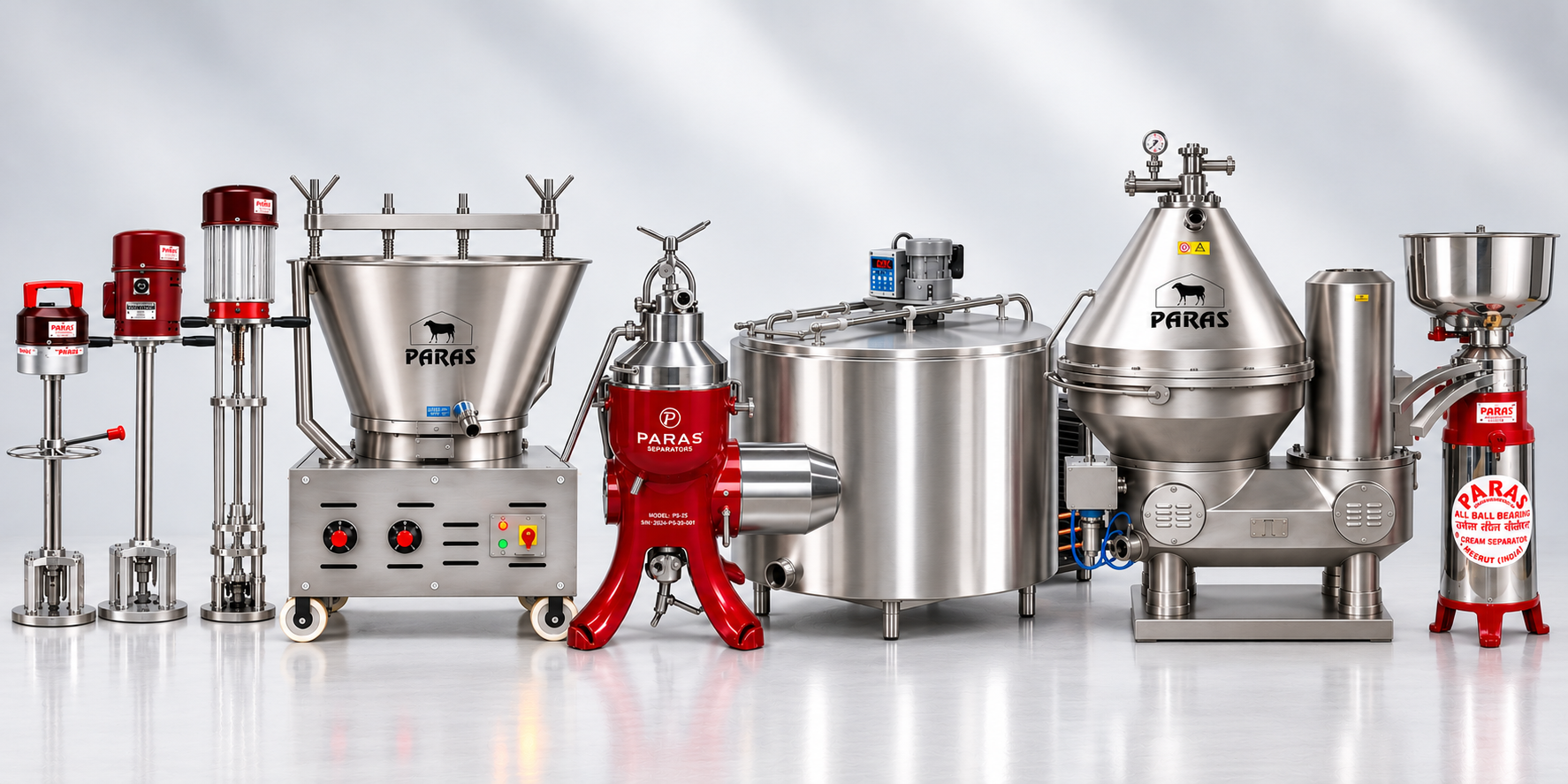
Cream separation is the process of separating cream from milk using centrifugal force. A cream separator works by spinning milk at high speed inside a specially designed bowl assembly. Due to the difference in density, cream and skim milk separate and move toward different outlets.
Milk contains water, fat, proteins, lactose, minerals, and solids-not-fat. The fat portion of milk is lighter than the liquid portion. When milk enters a rotating separator bowl, the heavier skim milk moves outward while the lighter cream moves inward. This principle allows cream and skim milk to be collected separately.
Main components of a cream separator
1. Bowl Assembly
The bowl is the heart of the cream separator. It rotates at high speed and creates centrifugal force.
2. Disc Stack
Discs increase the separation area inside the bowl. More discs help improve separation efficiency in higher-capacity machines.
3. Spindle
The spindle transfers rotation to the bowl assembly.
4. Milk Inlet
Milk enters the separator through the inlet system.
5. Cream Outlet
Separated cream exits through the cream outlet.
6. Skim Milk Outlet
Skim milk exits through a separate outlet.
Step-by-step cream separation process
Step 1: Milk enters the machine
Milk is fed into the separator through the tank or pump system depending on the model.
Step 2: Bowl rotates at high speed
The bowl rotates and generates centrifugal force.
Step 3: Fat separates from milk
The lighter cream moves inward while heavier skim milk moves outward.
Step 4: Cream exits separately
Cream flows out through the cream outlet.
Step 5: Skim milk exits separately
Skim milk flows out through the skim milk outlet.
Why disc count matters
Disc count affects separation efficiency and capacity. Small machines have fewer discs, while higher-capacity machines use more discs to handle larger milk volumes.
PARAS® examples
- GR 7: 10-12 discs
- GR 8: 14-16 discs
- GR 9: 20-22 discs
- GR 11: 30-32 discs
- GR 107: 34-36 discs
- GR 108: 38-40 discs
- GR A1/A2: 40-42 discs
- GR A3: 65-72 discs
Factors affecting cream separation
- milk temperature
- milk quality
- fat percentage
- bowl speed
- cleanliness
- correct assembly
- regular maintenance
- voltage stability in electric models
Common problems
- low cream output
- vibration
- improper separation
- milk leakage
- reduced output
- poor cleaning
These usually happen due to incorrect assembly, improper cleaning, worn parts, unstable operation, or milk quality variation.
How PARAS® supports efficient separation
PARAS® cream separators are engineered with carefully designed bowl assemblies, disc stacks, sturdy construction, and model-specific capacities to support reliable separation for dairy businesses.
Conclusion
Cream separation is a simple but highly precise process. The efficiency of the machine depends on correct design, proper bowl speed, disc arrangement, milk quality, and maintenance. A good separator helps dairy businesses improve productivity and product quality.
CTA
Explore PARAS® cream separator models from 60 LPH to 5000 LPH.
FAQs
What principle does a cream separator use?
A cream separator uses centrifugal force to separate cream from milk.
Why does cream separate from milk?
Cream is lighter than skim milk, so it separates under high-speed rotation.
What is the role of discs in a cream separator?
Discs increase separation area and improve efficiency.
Why is cleaning important?
Cleaning prevents residue buildup and ensures hygienic operation.
Does milk temperature affect separation?
Yes, milk temperature can affect separation efficiency.