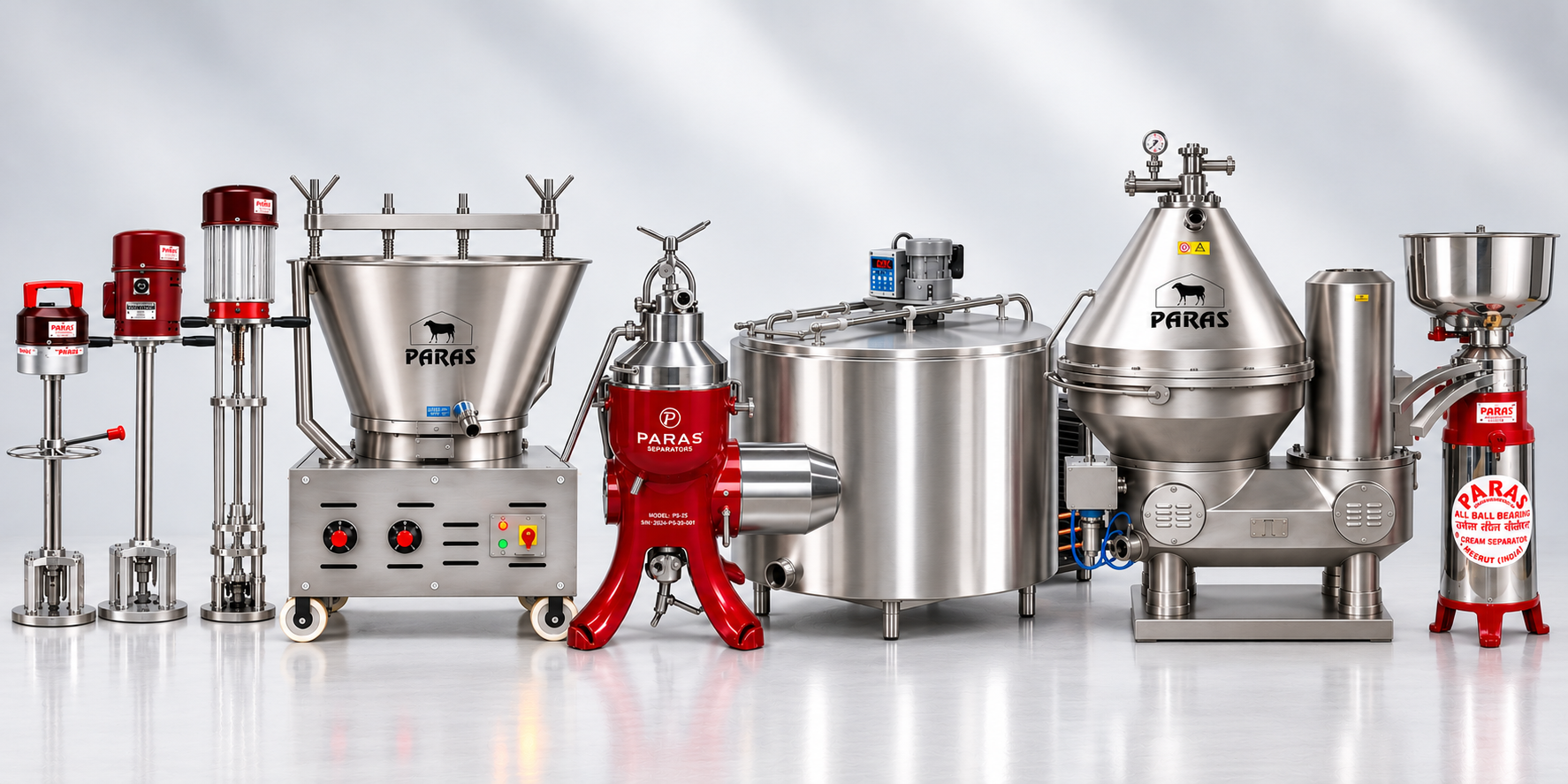
Choosing the right cream separator is one of the most important decisions for any dairy business. A machine that is too small will slow down production, increase labour, and limit growth. A machine that is too large may increase investment unnecessarily. The right cream separator should match your daily milk volume, working hours, milk type, labour availability, and future expansion plans.
A cream separator is used to separate cream from milk using centrifugal force. It helps dairy farmers, milk collection centres, sweet shops, commercial dairies, and milk processing units produce cream, skim milk, butter, ghee, and other dairy by-products efficiently.
Before choosing a cream separator, consider these factors
1. Daily milk volume
Estimate how much milk you process in a day and divide it by your working hours. This gives the required LPH capacity.
Daily milk quantity ÷ working hours = required LPH capacity
Example:
If you process 600 litres of milk in 3 hours, you need around 200 LPH capacity.
2. Type of milk
Buffalo milk generally has higher fat content than cow milk, so proper bowl speed, disc stack design, and stable operation become important.
3. Manual or electric operation
Manual models are useful in rural areas or where electricity is unreliable. Electric models are better for regular commercial operations and higher output.
4. Future expansion
Always choose a model that gives some room for growth. If your dairy is expanding, avoid selecting the lowest possible capacity.
PARAS® Cream Separator Capacity Guide
- GR 7 Series: 60 LPH
Suitable for small dairies, farms, and low-volume daily use. - GR 8 Series: 80-100 LPH
Suitable for small commercial dairies and regular milk handling. - GR 9 Series: 165 LPH
Suitable for growing dairy businesses and small collection centres. - GR 11 Series: 300 LPH
Suitable for commercial dairy operations requiring better output. - GR 107 Series: 450 LPH
Suitable for medium to large dairy businesses. - GR 108 Series: 600 LPH
Suitable for high-volume dairy operations and commercial processing. - GR 109 Series: 800 LPH
Suitable for larger dairies and pump-fed operations. - GR A1 Series: 1200 LPH
Suitable for milk plants and large-scale processing units. - GR A2 Series: 2000 LPH
Suitable for industrial dairy processing. - GR A3 Series: 3000 LPH
Suitable for large dairy plants and continuous operations. - 5000 LPH Auto-Cleaning Model
Suitable for industrial-scale cream separation and online processing systems.
Common mistakes buyers make
- choosing only by price
- ignoring daily milk volume
- selecting manual models for high-volume work
- not considering future growth
- ignoring service and spare parts availability
- not verifying technical specifications
Why choose PARAS®
PARAS® Cream Separators are manufactured by G.R. Jain Industries, a trusted Indian dairy machinery manufacturer since 1962. With capacities from 60 LPH to 5000 LPH, PARAS® offers machines for small dairies, commercial dairies, milk plants, and export markets.
Conclusion
The best cream separator is not always the biggest or cheapest machine. It is the machine that matches your milk volume, operation style, and business goals. For most buyers, choosing the right capacity from the beginning saves time, labour, and long-term cost.
CTA
Need help selecting the right model? Contact the PARAS® technical team for capacity recommendation.
FAQs
Which cream separator is best for small dairy farms?
For small dairy farms, GR 7 or GR 8 models are usually suitable depending on milk volume.
Which model is suitable for 600 LPH?
PARAS® GR 108 Series is suitable for 600 LPH operations.
Should I choose manual or electric cream separator?
Manual models are better for low-volume or electricity-limited areas. Electric models are better for regular commercial use.
What capacity is suitable for milk plants?
Milk plants generally require 1200 LPH, 2000 LPH, 3000 LPH, or 5000 LPH models.
Can one machine process both cow and buffalo milk?
Yes, but performance depends on milk quality, fat percentage, temperature, and correct operation.