INDUSTRIAL DAIRY STANDARD · FOOD GRADE SS 304 · PRECISION WHEY EXPULSION

World-Class Commercial Manual & Pneumatic Paneer Press Machines

The definitive choice for commercial dairies, sweet shops, and food processing plants. Engineered by G.R. Jain Industries in Meerut, our paneer presses are built with heavy-gauge stainless steel contact surfaces to deliver uniform, export-quality block formation. Available in tactile manual configurations or automated pneumatic systems to suit any production scale.
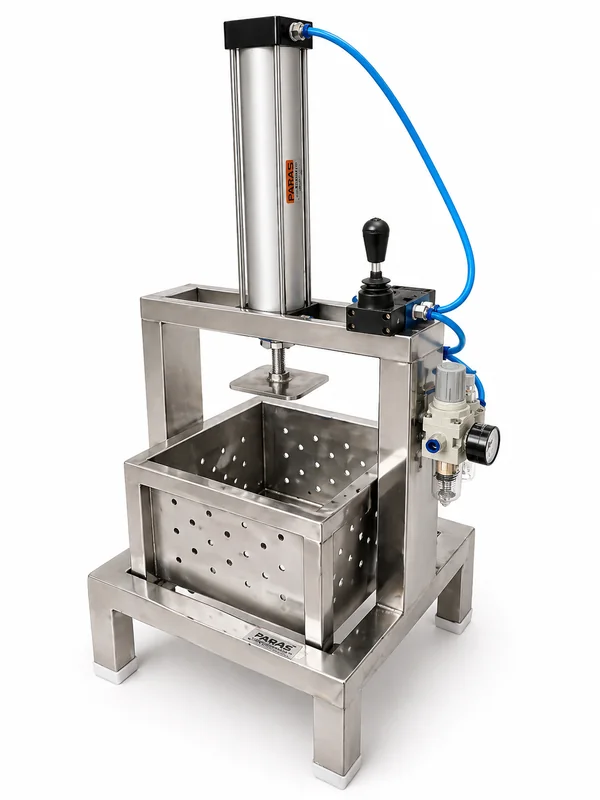
PARAS single hoop pneumatic paneer press
PARAS® Paneer Press
Since 1962G.R. Jain Industries
Manual & pneumaticCapacities across the range
Three configurations6–50 kg batch range
Meerut, IndiaManufacturer enquiry and support

Explore PARAS Paneer Presses

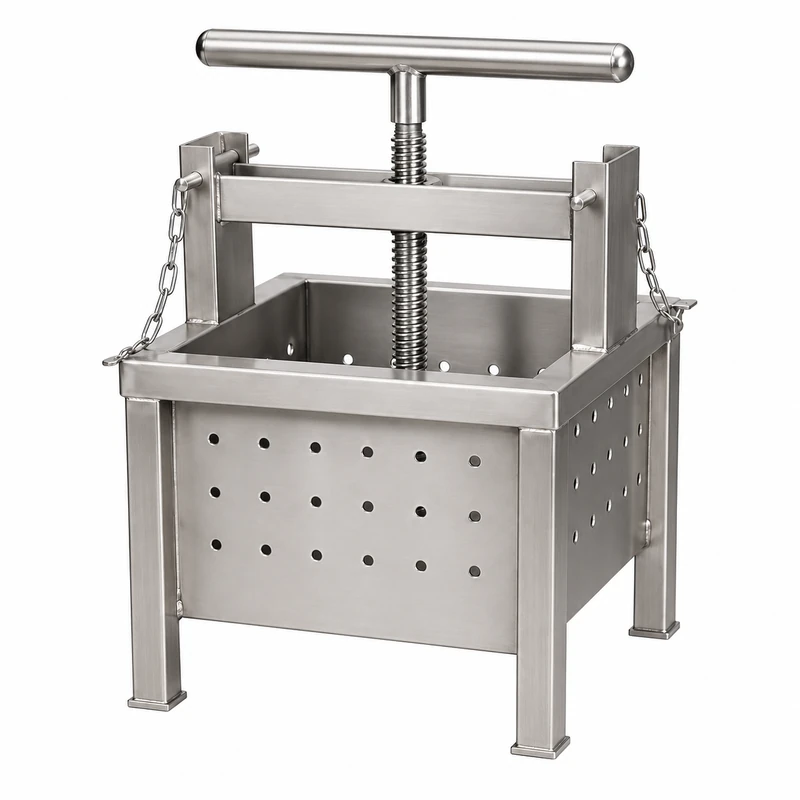
PARAS Manual Paneer Press
PARAS · SS 304 CONTACT

Manual Paneer Press

Moulds: 10 × 10, 10 × 12, 12 × 12 inches

Batch capacity
6–12 kg
Operation
Screw type
Enquire for this model
PARAS Single Hoop Pneumatic
PARAS · SS 304 CONTACT

Single Hoop Pneumatic

Uniform pneumatic block pressing

Batch capacity
5–15 kg
Operation
6–8 bar air supply
Enquire for this model
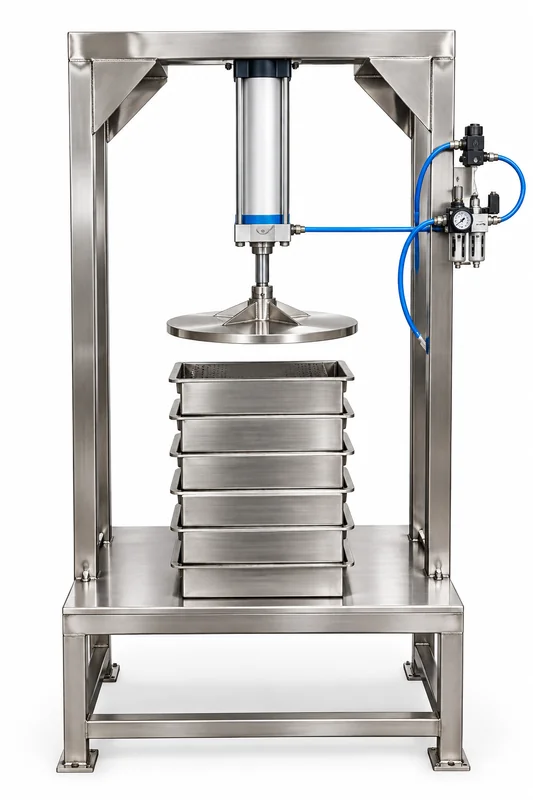
PARAS Multi-Hoop Pneumatic
PARAS · SS 304 CONTACT

Multi-Hoop Pneumatic

Uniform pneumatic block pressing

Batch capacity
Up to 50 kg
Operation
6–8 bar air supply
Enquire for this model

Full Technical Specifications

ParameterManual pressPneumatic press
MaterialSS 304 food-contact partsSS 304 food-contact parts
Batch capacity6–12 kgSingle: 5–15 kg; Multi: up to 50 kg
Standard moulds10 × 10, 10 × 12, 12 × 12 inchesConfigured to requirements
Pressing mechanismScrew typePneumatic cylinder
Power sourceHand operatedExternal air compressor
Working pressureNot applicable6–8 bar, adjustable
OperationHand leverPush button / lever
DimensionsCustomizableCustomizable

Engineering Advantages & Mechanisms

PARAS® paneer presses are built for grueling food production environments where hygiene, repeatability, and serviceability matter.

  • Pneumatic Automation: Our pneumatic models utilize industrial air cylinders operating at an adjustable 6-8 bar pressure, providing a "set-and-forget" workflow for busy plant operators.
  • Manual Precision: Our heavy-duty screw mechanisms are finely threaded, ensuring smooth descent and allowing traditional halwais to feel the curd resistance as it forms.
  • SS 304 Food-Contact Construction: We strictly use dairy-grade Stainless Steel for all pressing plates, trays, and moulds to ensure absolute hygiene and prevent acidic whey corrosion.

Paneer Press Prices & Factory-Direct Matrix

Indicative factory pricing. Final quotes depend on configuration, dimensions and number of pressing stations.

ConfigurationConstructionIndicative price (INR)
Manual press, includes one mouldAll parts SS 304, including frame₹15,000–₹25,000
Single hoop pneumaticSS 304 press plates and trays₹50,000–₹85,000
Multi-hoop pneumaticHeavy SS 304 structure₹90,000–₹1,60,000+

Applicable taxes and eligibility for input tax credit are confirmed in the final quotation.

Material Constructions & Key Components

  • Interchangeable Mould Hoops: Manual systems are compatible with our precision-welded SS 304 hoops, ensuring sharp 90-degree block corners without bulging.
  • Whey Drainage Trays: Integrated sloping collection trays with peripheral spouts ensure expelled whey is channeled away instantly without bacterial pooling.
  • Heavy-Duty Pneumatic Cylinders: Built for millions of compression cycles without pressure drop. Supplied with fine-tuned regulators for precise control.
  • Sturdy Chassis: Built to absorb the extreme downward force required to expel moisture from dense protein matrices without warping or bending over time.

How the Pressing Process Works

The pressing stage transforms loose cooked curd into firm, uniform blocks with standard commercial moisture content (typically 50–55%).

  • Loading: Hot, drained curd is packed evenly into the SS 304 hoops lined with porous muslin cloth.
  • Alignment: Hoops are centered under the press heads.
  • Compression: The manual lever is cranked, or the pneumatic valve is engaged to lower the press plate.
  • Expulsion: Sustained pressure forces out the remaining whey through the cloth perforations. The press holds for 30 to 45 minutes until the curd knits together.
  • Chilling: The solid block is demoulded and plunged into chilled water to set its structural integrity.

Applications & Who Is It Suitable For?

The PARAS® Paneer Press is used in practical operations where consistent block shape and repeatable pressure matter.

  • Suitable For: Paneer manufacturers, dairy units, sweet shops, commercial kitchens, small and medium dairy businesses, and food processing units.
  • Core Applications: Paneer block pressing, curd pressing, and uniform paneer shaping for wholesale cubing and packaging.

PARAS vs. Competitor Machines

ParameterBasic local fabricationPARAS paneer presses
Material integrityThin sheets may deformHeavy-gauge SS 304 contact zones
Mould accuracyVariable dimensionsPrecision mould hoops
Pressure stabilityVariable pneumatic controlAdjustable 6–8 bar regulation
Whey drainageFlat collection traysSloping channels and drain spouts

Yield & Labour Efficiency

  • Yield Optimization: Inconsistent pressing crushes curd (destroying texture) or leaves it too wet (causing spoilage). A calibrated Paras press ensures optimal moisture retention, maximizing your kg-per-liter saleable weight.
  • Labor Efficiency: A multi-hoop pneumatic press allows one operator to press vast quantities simultaneously, replacing the physical effort of stacking heavy weights. Commercial dairies routinely recover the capital cost of our presses within 2 to 3 months through labor savings and zero batch waste.

Why Buy Direct from PARAS

By purchasing directly from our manufacturing headquarters in Meerut, you bypass middleman markups and secure factory-level support.

  • Eliminate Middleman Markups: Regional dealers and trading houses inflate prices by 20% to 40%. Buying direct secures the absolute lowest factory-gate pricing.
  • Manufacturing Legacy: Operating a family-owned manufacturing business, we specialize entirely in the heavy engineering of paneer presses and dairy equipment. We manufacture; we do not just assemble.
  • Complete Customization Control: Direct buyers can dictate specific motor voltages, material upgrades, and customized export packaging that third-party resellers cannot accommodate.
  • Direct OEM Warranty & Spares: Deal directly with the engineers who built your machine. We dispatch OEM components directly from our factory floor.
  • Export & White-Labeling Authority: For international trading houses, we provide seamless white-label manufacturing, custom branding, and comprehensive export documentation (Certificate of Origin, Test Certificates).

Frequently Asked Questions

What are the standard block capacities for the Manual Paneer Press?

Our manual presses utilize three standard mould sizes: 10" x 10" (yields a 6-8 Kg block), 10" x 12" (yields an 8-10 Kg block), and 12" x 12" (yields a 10-12 Kg block).

What is the capacity range for the Pneumatic Paneer Press?

Single hoop pneumatic models handle 5 Kg to 15 Kg per batch. Multi-hoop configurations offer massive, customizable batch capacities scaling up to 50 Kg to suit industrial plant volumes.

Does the pneumatic press come with an air compressor?

No, the air compressor is sourced separately. The machine requires a standard industrial air compressor capable of maintaining an adjustable working pressure of 6 to 8 Bar.

How long should I press the paneer for optimal firmness?

For commercial-grade density, paneer is typically pressed for 30 to 45 minutes. This ensures maximum whey expulsion while allowing the protein matrix to bind securely for clean slicing.

Are the food contact parts made of food-grade material?

Yes, absolutely. All pressing plates, collection trays, and moulding hoops are constructed from heavy-gauge SS 304 stainless steel to ensure strict compliance with dairy hygiene standards.

Can I upgrade a single hoop pneumatic press to a multi-hoop later?

It is more cost-effective to order the correct chassis size upfront. Multi-hoop systems require a wider, structurally reinforced heavy-duty frame to handle simultaneous cylinder pressure safely.

Is the equipment easy to clean?

Yes, the system features an easy-to-clean, low-maintenance design. Operators simply need to wash down the smooth SS 304 food-contact surfaces and clear the drainage trays after every batch.

Do you provide spare parts and factory support?

Yes. As direct manufacturers, PARAS® provides spare parts and technical support for long-term operation. Buyers can contact the factory directly for immediate guidance and part dispatches.

Secure Your Direct Quote or Export Inquiry