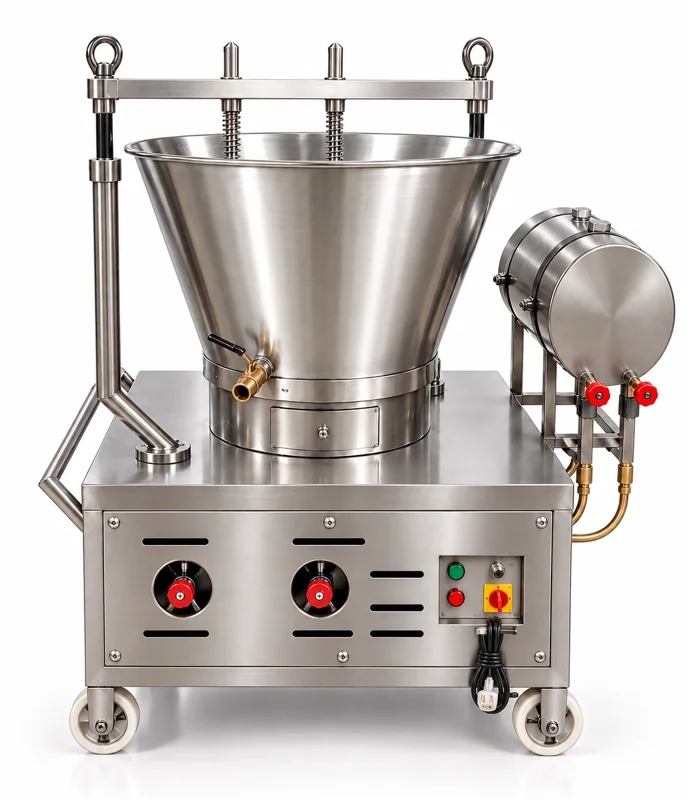
60L
Total vessel volume
- Milk per batch
- ≈ 35 litres
- Motor power
- 0.5 HP
HEAVY-DUTY INDUSTRIAL STANDARD • SS 304 FOOD GRADE • ZERO-BURN TECHNOLOGY
The definitive choice for high-volume sweet shops (halwais), commercial catering businesses, and large-scale dairy processing plants. Engineered in Meerut with massive 20mm thick SS 304 vessels, high-torque planetary gearboxes, and spring-loaded Teflon scrapers for 100% automated, zero-burn milk evaporation.
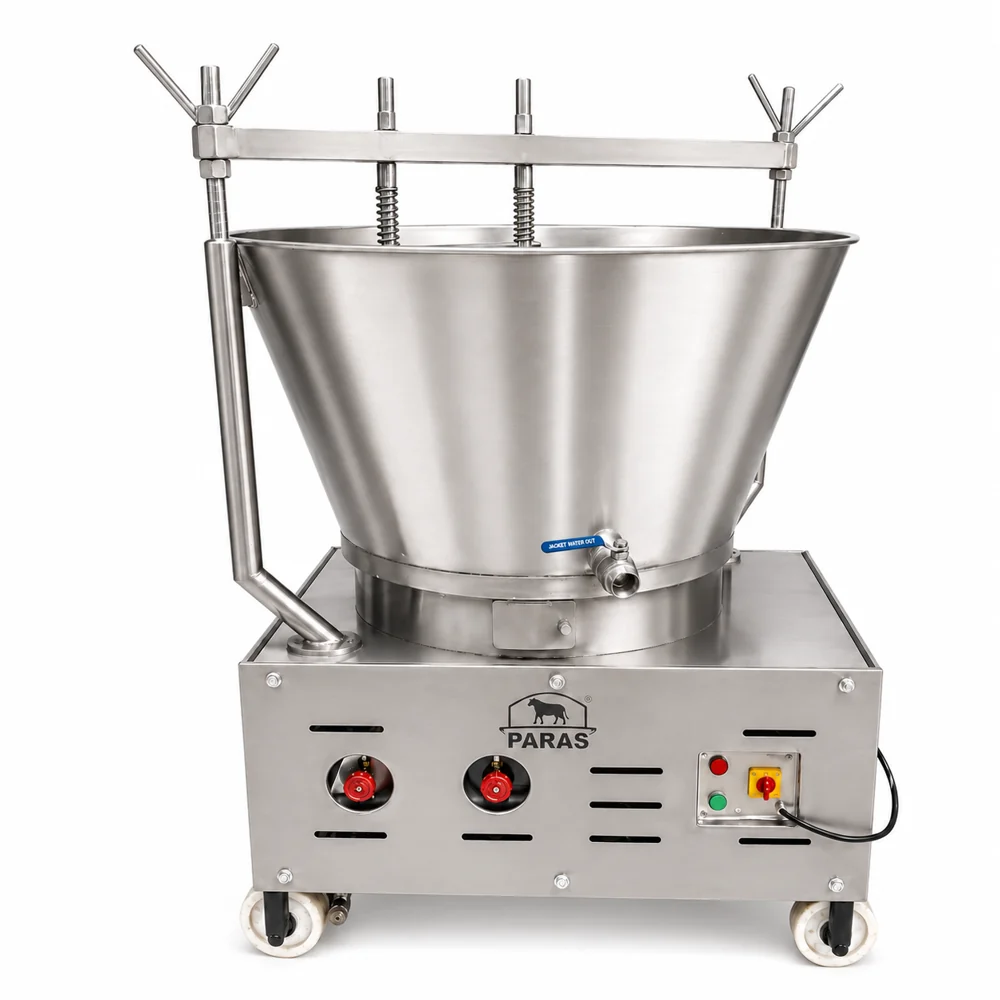
Choose your vessel size. Milk batch capacity is lower than total vessel volume.
Total vessel volume
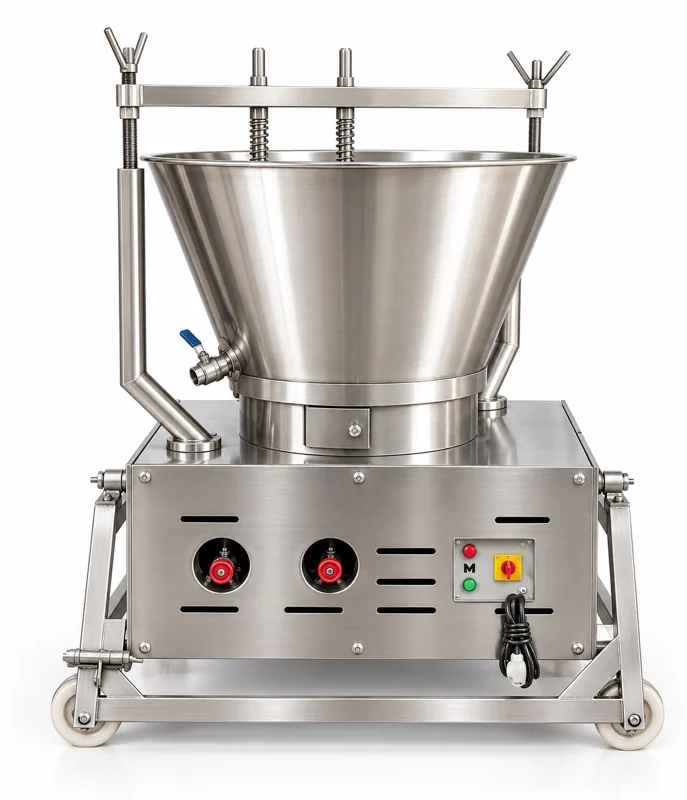
Total vessel volume
Total vessel volume
Total vessel volume
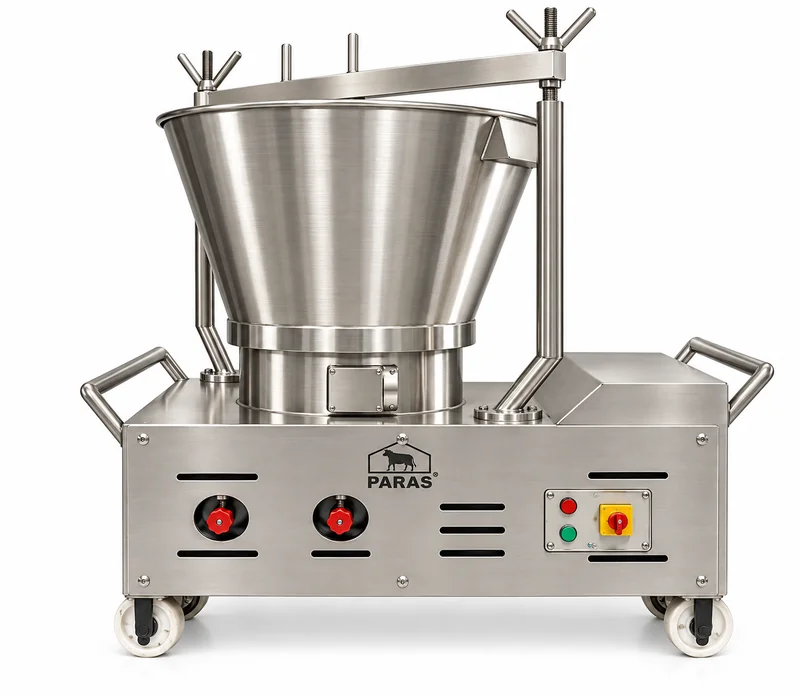
Total vessel volume
| Model | Dimensions (in) | Burners | Fuel | Motor | Weight | Boiling / batch | Khoya / batch |
|---|---|---|---|---|---|---|---|
| MIG1 | 48×28×36 | 2 | LPG / Biogas | 1 HP | 130 kg | 80 L / 20 min | 10 L / 20 min |
| MIO1 | 48×28×36 | 2 | Kerosene / Diesel | 1 HP | 130 kg | 60 L / 20 min | 10 L / 20 min |
| MIOG1 | 48×28×36 | 2+2 | Kerosene / Diesel / LPG | 1 HP | 130 kg | 60 L / 20 min | 10 L / 20 min |
| Model | Dimensions (in) | Burners | Fuel | Motor | Weight | Boiling / batch | Khoya / batch |
|---|---|---|---|---|---|---|---|
| MIG2 | 53×30×36 | 2 | LPG / Biogas | 1 HP | 200 kg | 125 L / 30 min | 15 L / 30 min |
| MIO2 | 56×30×36 | 2 | Kerosene / Diesel / LPG | 1 HP | 150 kg | 100 L / 30 min | 20 L / 30 min |
| MIOG2 | 48×28×36 | 2+2 | Kerosene / Diesel / LPG | 1 HP | 150 kg | 120 L / 30 min | 20 L / 30 min |
| Model | Dimensions (in) | Burners | Fuel | Motor | Weight | Boiling / batch | Khoya / batch |
|---|---|---|---|---|---|---|---|
| MIG3 | 62×42×40 | 3 | LPG / Biogas | 3 HP | 350 kg | 225 L / 40 min | 50 L / 40 min |
| MIO3 | 62×42×40 | 3 | Kerosene / Diesel | 3 HP | 300 kg | 250 L / 40 min | 50 L / 40 min |
When selecting a commercial Khoya machine, it is critical to understand the difference between Total Vessel Volume and Actual Milk Processing Capacity. Because milk boils and foams vigorously, the vessel can only be safely filled to about 40–50% of its total capacity to prevent spillover.
Match your daily processing volume with our engineered capacity models:
| Total Vessel Volume | Safe Milk Capacity (Per Batch) | Standard Motor Power | Ideal Commercial Use Cases |
|---|---|---|---|
| 60L (Compact) | ≈ 35 litres | 0.5 HP | Local sweet shops, micro-dairies, catering startups, and restaurant kitchens. |
| 120L (Commercial) | ≈ 70–80 litres | 1.0 HP | Medium-volume halwais and daily fresh Rabri/Basundi production. |
| 200L (High-Yield) | ≈ 120 litres | 1 HP | High-volume regional sweet manufacturers, wedding caterers, and collection centers. |
| 350L (Industrial) | ≈ 225 litres | 3 HP | Medium-scale dairy processing units and bulk sweet exporters. |
| 500L (Heavy Industrial) | ≈ 300+ litres | 3.0 HP (3-Phase) | Large dairy factories and state-level cooperatives. Replaces 4+ manual laborers per shift. |
We specialize in manufacturing highly efficient direct-fired heating architectures tailored to your specific infrastructure and local fuel costs.
Transparent pricing from our Meerut manufacturing hub. Exact quotes vary based on heating configuration (Gas vs. Diesel) and motor horsepower.
| Vessel Capacity | Standard Material Construction | Indicative Domestic Price (INR) | Estimated Export Price (USD) |
|---|---|---|---|
| 60L – 120L | SS 304 Pan / Heavy Bottom | ₹54,000 – ₹90,000 | $660 – $1,080 |
| 200L | Heavy SS 304 / 20mm Bottom | ₹1,02,000 – ₹1,32,000 | $1,260 – $1,620 |
| 350L – 500L | Extra-Heavy SS 304 / Planetary Drive | ₹1,50,000 – ₹2,50,000+ | $1,850 – $3,100+ |
Under Indian tax regulations, commercial dairy processing machinery is strictly subject to an 18% GST rate. Registered commercial businesses and authorized dealers are fully eligible to claim Input Tax Credit (ITC) on their purchases.
Uncompromising build quality defines Paras Equipment. We do not use mild steel (MS) for any food-contact parts.
This machine completely automates the most labor-intensive process in the Indian dairy industry: continuous evaporation.
Raw milk is poured into the SS 304 vessel, and the primary heating source (LPG, Diesel, or Wood) is ignited through the high-efficiency burner setup. The electric motor drives the stirring assembly at a precise, constant RPM. As the milk boils rapidly and water evaporates, milk solids attempt to stick to the hot 20mm bottom surface.
The spring-loaded Teflon scrapers continuously sweep the entire surface area of the hot pan, lifting the solids back into the boiling liquid. This relentless automated scraping prevents scorching, controls boil-overs, and ensures a perfectly uniform, grain-free texture until the milk successfully reduces into thick Khoya/Mawa.
A Paras Khoya machine is not a single-use tool; it is a universal commercial cooking kettle. By adjusting the boiling time and heat intensity, a single machine produces:
When evaluating Paras machinery against mass-market alternatives found on B2B directories, the difference in engineering guarantees long-term profitability.
| Engineering Parameter | Cheap Local Manufacturers | Paras Khoya Machines |
|---|---|---|
| Vessel Bottom Thickness | 3mm to 5mm (Prone to warping & burning) | Massive 20mm Heavy-Gauge SS 304 |
| Scraper Blades | Rigid metal or cheap plastic (Scratches pan) | Spring-Loaded Food-Grade Teflon (PTFE) |
| Burner Architecture | Standard single-ring iron burner | Custom multi-ring high-pressure setup |
| Tilting Safety | Unbalanced manual pivot (High burn risk) | Precision Worm-Gear Handwheel |
The financial return on a Paras automated Khoya machine is driven entirely by labor elimination and product saving.
1. The Labor Cost: Making 100 kg of Khoya manually requires 2 to 3 skilled laborers standing over blistering heat, stirring continuously for hours. A single Paras machine replaces all three laborers entirely.
2. The Burning Loss: Manual stirring inevitably results in 5% to 8% of the milk scorching to the bottom of the pan, ruining the color and wasting yield. The 20mm base combined with the Paras Teflon scraper system recovers 100% of the yield.
The Payback: By saving ₹40,000 to ₹60,000 monthly on manual halwai labor wages and eliminating burnt milk waste, commercial sweet shops recover their entire capital investment within 2 to 3 months of operation.
By purchasing directly from our manufacturing headquarters in Meerut, you bypass middleman markups and secure factory-level support.
Maximizing the lifespan of your machine requires disciplined operational routines and reliable backup support.
High-pressure LPG burners produce intense, localized heat. A standard thin pan (3mm-5mm) will develop "hot spots," warp under the thermal stress, and instantly burn the milk. Our massive 20mm bottom absorbs the direct flame and disperses the heat evenly across the entire surface of the pan, guaranteeing zero burning and lifelong durability.
No. This is the primary advantage of the Paras system. The spring-loaded arms press the food-grade Teflon (PTFE) scrapers directly against the 20mm thick SS 304 bottom. Because they scrape the entire surface continuously at a steady RPM, milk solids are lifted before they have the chance to scorch, guaranteeing bright, white Khoya.
Khoya yield depends on the milk’s total solids and the final moisture level, not just litres loaded into the vessel. Cow and buffalo milk can produce different yields, and reducing one batch further will lower its finished weight. For a useful production trial, use milk with a consistent composition, record the starting quantity, and compare batches at the same final consistency. Do not treat vessel capacity as a guaranteed khoya output.
Yes, Teflon blades are wear-and-tear consumables. Under heavy commercial use, they should be inspected monthly. When they wear down, they are easily unbolted from the SS stirrer arms with a standard wrench. We keep thousands of replacement PTFE blades in factory stock.
If a machine stalls, it means you have overloaded the rated milk capacity (e.g., pouring 90 liters into a 60L machine) or are experiencing severe electrical voltage drops. Ensure your facility is supplying the correct voltage (use a stabilizer if necessary) to maintain peak motor torque.
Yes. We configure the high-pressure brass burner setups for local LPG, PNG, or natural gas standards. We also configure all electric motors to match your destination's exact grid standards (110V/60Hz, 220V/50Hz, or 3-Phase 380V/415V). The stirrer assembly is secured, and the entire machine is packed in heavy-duty, ISPM-15 certified fumigated wooden crating. This prevents transit damage and complies with strict international customs agricultural regulations.
Switch off the heat and isolate the electrical supply before cleaning. Once the vessel is safe to handle, remove product residue with warm water and a food-equipment cleaning agent suitable for stainless steel. Clean the scraper edges and accessible joints carefully, rinse thoroughly, and dry before reuse. Avoid abrasive tools that damage the vessel or scraper surfaces, and keep water away from the motor and electrical controls. Follow the supplied model-specific cleaning instructions.
Use a consistent milk composition and starting load, then record the heating setting, batch time, and finished weight. As the milk thickens, watch the texture and reduce heat as needed rather than relying only on a fixed timer. Discharge at the same target consistency each time, since further evaporation changes both texture and yield. Agree on the desired finished product during a trial batch before setting a production routine.